scallops guide
Scallop types: sea, bay and size
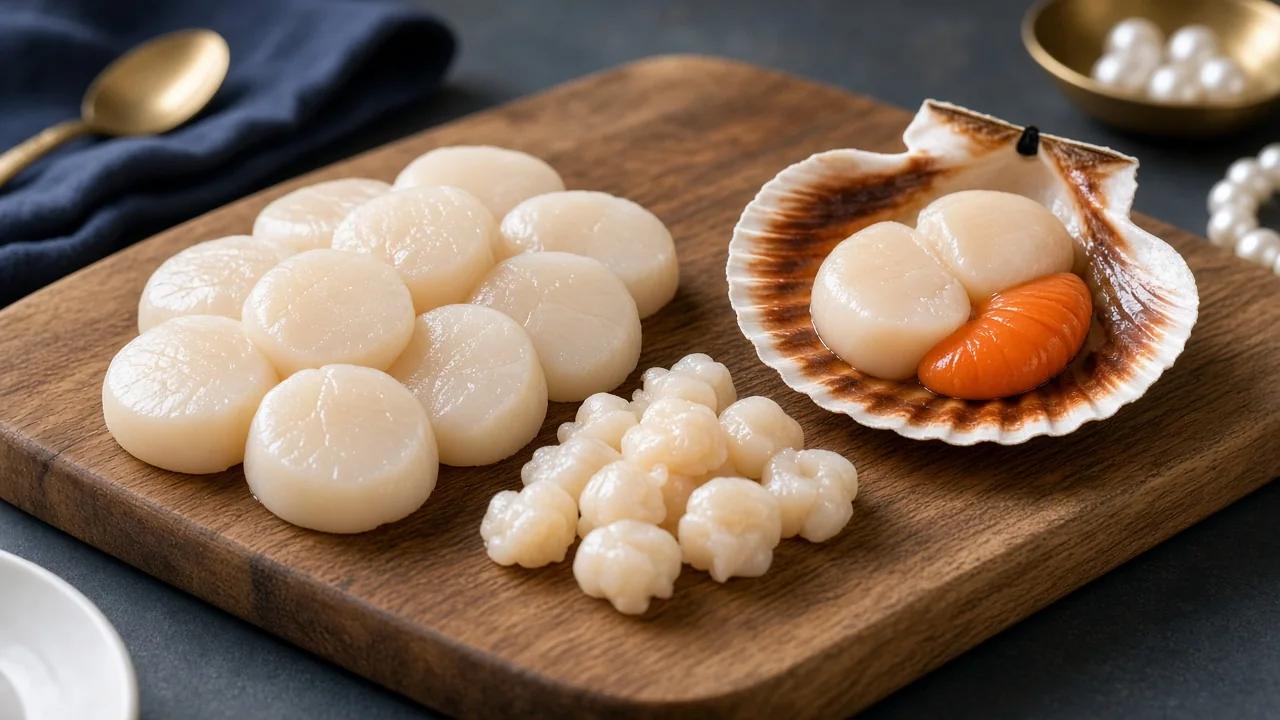
Species guide · Pectinidae (Placopecten magellanicus, Pecten maximus, Argopecten irradians and others)
Scallops
Scallops are bivalve shellfish prized for their sweet, rich, tender white adductor muscle, and a perfectly seared scallop with a golden crust is one of the great restaurant dishes you can make at home in 3 minutes.
US species
Atlantic sea scallop (*Placopecten magellanicus*) (NOAA Fisheries)
UK species
king scallop and queen scallop (MCS)
Taste
sweet and rich; can be mild or briny (NOAA)
Texture
firm and lean (NOAA)
Scallops are sweet, quick to cook and easy to get wrong. Start with the types and names.
Mercury
Scallops are on the FDA Best Choices list for low mercury.
Sea Scallops vs Bay Scallops
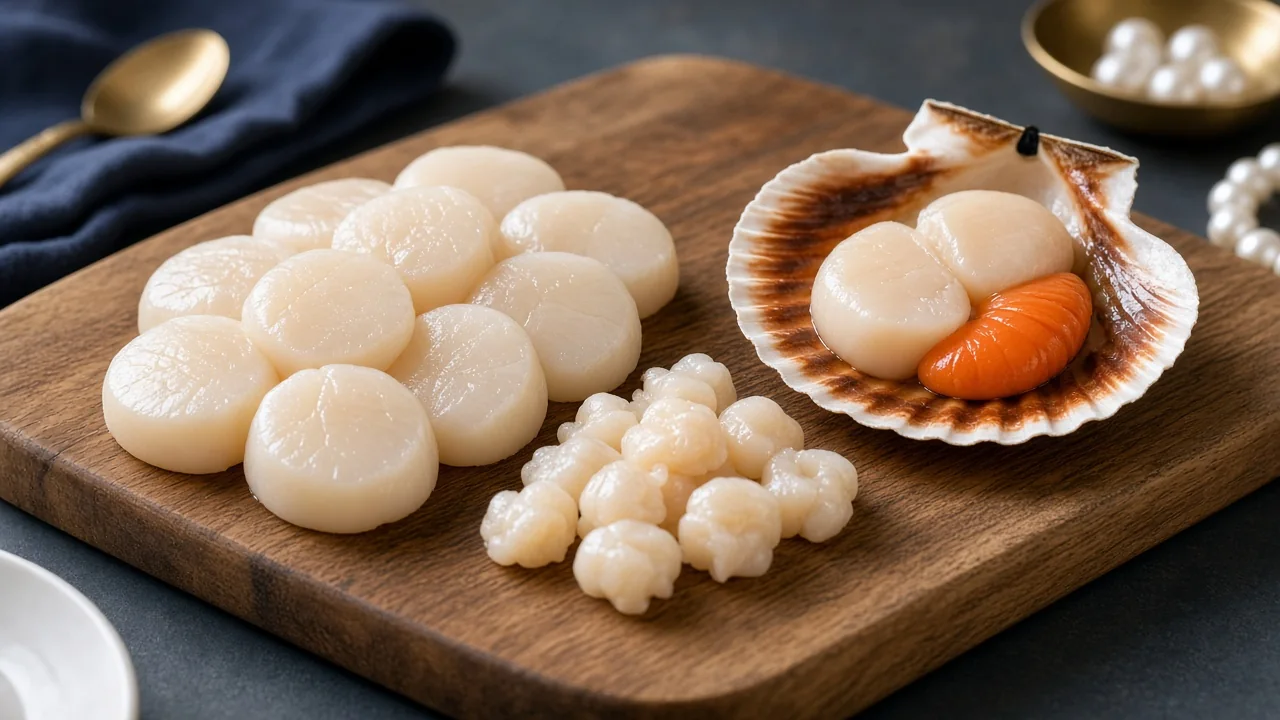
- Size
- Sea scallops: Large; a few per serving
- Bay scallops: Small; many per serving
- Where they live
- Sea scallops: Deeper offshore waters (Atlantic sea scallop)
- Bay scallops: Shallow bays and estuaries
- Taste
- Sea scallops: Sweet and meaty
- Bay scallops: Sweeter and more delicate
- Best cooking
- Sea scallops: Hard sear in a hot pan
- Bay scallops: Quick sauté, pasta, gratins
- Common mistake
- Sea scallops: Overcooking makes them rubbery
- Bay scallops: They cook in moments; add them last
| Sea scallops | Bay scallops | |
|---|---|---|
| Size | Large; a few per serving | Small; many per serving |
| Where they live | Deeper offshore waters (Atlantic sea scallop) | Shallow bays and estuaries |
| Taste | Sweet and meaty | Sweeter and more delicate |
| Best cooking | Hard sear in a hot pan | Quick sauté, pasta, gratins |
| Common mistake | Overcooking makes them rubbery | They cook in moments; add them last |
How to tell them apart
- Sea scallops are noticeably larger than bay scallops.
- "Dry" scallops have no added water; "wet" scallops were soaked and may weep in the pan.
Sources: NOAA Fisheries – Atlantic Sea Scallop · US FDA – The Seafood List
Scallop Nutrition (Per Serving)
Scallops are a lean, high-protein shellfish that is low in fat. They also provide vitamin B12, phosphorus and selenium. For exact figures for a serving of raw or cooked scallops, see USDA FoodData Central.
Scallops are low in mercury and are on the FDA's "Best choices" list. Like all shellfish, they are a major food allergen. Scallops sold "wet" (soaked in a phosphate solution) carry extra water and sodium, which is one reason cooks prefer "dry" scallops.
Sources: USDA FoodData Central · US FDA – Advice about Eating Fish
Best Ways to Cook Scallops
Our step-by-step scallop recipe page covers searing in detail; the tips tab covers temperatures, timing and mistakes.
- Sear sea scallops hard in a very hot pan for a golden crust and a just-translucent centre.
- Grill or broil them on skewers, brushed with butter or oil.
- Add bay scallops to pasta, gratins and chowder at the very end; they cook in moments.
- Serve very fresh sea scallops raw as crudo or ceviche only if they are sold for raw eating.
Sustainability and Sourcing
Atlantic sea scallops from the US are managed by NOAA Fisheries under a federal plan, and they are a large and valuable fishery. Bay scallops are harvested in smaller amounts along the US East Coast, and many sold in the US are imported. Farmed scallops come mainly from Asia.
Ask for the species and country of origin, look for MSC (wild) or ASC (farmed) labels, and check Seafood Watch for a given source.
Sources: NOAA Fisheries – Atlantic Sea Scallop · Marine Stewardship Council · Aquaculture Stewardship Council · Monterey Bay Aquarium Seafood Watch
Featured Scallop Recipe
Our featured scallop recipe walks you through a restaurant-style pan sear, with photos of every step.
Where to Eat Scallops
We list restaurants whose own menus show scallops, city by city, across the US, UK and Europe.
What Is a Scallop?
A scallop is a bivalve shellfish, a relative of clams, oysters and mussels, with two fan-shaped shells. Unlike most bivalves, scallops can swim: they clap their shells together to jet through the water. The round white "scallop" you buy is the adductor muscle that does this work, which is why it is so sweet and tender.
In the US, scallops are almost always sold shucked, as the adductor muscle alone. In Europe they are often sold in the shell or with the orange or cream-colored roe (the coral) still attached. Whole and roe-on scallops fall under shellfish sanitation rules, because toxins from algae can build up in the other parts of the animal.
Sources: NOAA Fisheries – Atlantic Sea Scallop · US FDA – National Shellfish Sanitation Program (NSSP)
Sea, Bay, Calico and Diver Scallops
Sea scallops are the large scallops sold for searing. In the US most are Atlantic sea scallops from the Northeast. Bay scallops are small and sweet and come from shallow bays. Calico scallops are a small, warm-water species, often sold cheaply as "bay scallops", so read the label. "Diver scallops" are hand-gathered by divers rather than dredged; the term is not regulated, so ask the seller what it means for their stock.
In the UK and Europe you will see king scallops, which are large, and queen scallops, which are small. Japanese hotate scallops are widely farmed and are often sold frozen for sushi.
Sources: NOAA Fisheries – Atlantic Sea Scallop · US FDA – The Seafood List
Can You Eat Scallops Raw?
Raw scallops appear as crudo, ceviche and sashimi, and the adductor muscle is the part eaten raw. Only eat scallops raw if they are sold for raw eating by a trusted supplier, kept very cold, and very fresh. The FDA advises that raw or undercooked seafood carries a higher risk of foodborne illness, especially for pregnant women, young children, older adults and anyone with a weakened immune system. Ceviche "cooks" in citrus only in taste and texture, not in safety.
Source: US FDA – Selecting and Serving Fresh and Frozen Seafood Safely
Scallops vs Shrimp
Scallops and shrimp are often swapped in pasta, stir-fries and skewers. Scallops are softer and more delicate, with a buttery sweetness, and they are best seared hard and left just set in the middle. Shrimp are firmer and springier and handle more sauce and spice. Both cook in minutes and both turn rubbery when overcooked. Both are on the FDA's "Best choices" list for lower mercury, and both are shellfish allergens.
Types of Scallops and Common Names
Scallop names vary by country, which makes menus and labels confusing. This table shows the scallops you are most likely to see.
| Name | Where it comes from | Size | Notes |
|---|---|---|---|
| Atlantic sea scallop | US Northeast and Atlantic Canada | Large | The main US scallop; wild-caught by dredge |
| Bay scallop | Shallow bays on the US East Coast; many imported | Small | Sweet and tender; seasonal |
| Calico scallop | Warm waters of the southeast US and Gulf | Small | Sometimes sold as "bay scallops" |
| King scallop | UK and northern Europe | Large | Often sold with roe, in the shell |
| Queen scallop | UK and northern Europe | Small | Quick to cook; good in pasta |
| Japanese scallop (hotate) | Japan and northern Pacific; widely farmed | Large | Common frozen and for sushi |
Sources: NOAA Fisheries – Atlantic Sea Scallop · US FDA – The Seafood List
Scallop Roe (Coral)
The roe is the crescent-shaped orange or cream part attached to the muscle. In the UK and France it is often cooked and eaten with the scallop; it is softer and richer, with a stronger flavor. In the US it is usually removed before sale. If you buy roe-on scallops, you can sear the roe with the muscle, or trim it off and use it in sauces and butters.
When Are Scallops in Season?
Scallops are sold all year, because most are frozen soon after harvest. Fresh, never-frozen scallops depend on local seasons and fishery openings, which differ by region and species. In the US, the Atlantic sea scallop fishery runs under NOAA Fisheries rules that open and close specific areas, and bay scallop seasons are set by individual states. Ask your fishmonger what is fresh this week.
How to Store Scallops
Keep fresh scallops in the fridge and cook them within a day or two, or freeze them. The where-to-buy tab covers choosing, storing and thawing scallops in more detail.
How Scallops Are Served Around the World
In France, coquilles Saint-Jacques are baked in the shell with a creamy sauce and breadcrumbs, and seared scallops are a fixture of bistro menus. In the UK, king scallops are often seared with black pudding or bacon and served with pea purée. In the US, sea scallops are seared in brown butter, wrapped in bacon, or fried in seafood baskets, and bay scallops go into chowders and pasta. In Japan, hotate is eaten raw as sashimi and sushi, grilled in the shell with soy and butter, or dried for broths.
Whatever the style, the best scallop dishes keep the cooking short so the scallop stays sweet and tender in the middle.
What to Use Instead of Scallops
If scallops are unavailable, large shrimp are the easiest swap in pasta, skewers and stir-fries. Monkfish tail, cut into thick medallions, can be seared like sea scallops and has a similarly firm, sweet bite. For a seared starter, thick pieces of halibut or cod loin also take a good crust. None will taste quite the same, so keep the seasoning simple and let the seafood lead.
What Goes With Scallops
Scallops are sweet and delicate, so they pair best with flavors that add richness, acidity or a little salt. Classic partners include brown butter, lemon, bacon or pancetta, peas, sweetcorn, cauliflower purée, risotto and fresh herbs such as chives and parsley. Crisp white wines like Chablis, Albariño or Sauvignon Blanc work well with seared scallops. For more ideas, see our scallop cooking tips.
For a simple weeknight plate, serve seared scallops over buttered greens or a lemony salad with crusty bread to soak up the pan juices.
FAQs
Are scallops healthy to eat?
Scallops are lean, high in protein and low in mercury. They are a shellfish allergen.
What do scallops taste like?
Sweet, mild and buttery, with a gentle brininess. Bay scallops are sweeter and more delicate than sea scallops.
Are scallops high in mercury?
No. Scallops are on the FDA's "Best choices" list for lower mercury.
Are scallops farmed or wild?
Both. US sea scallops are wild-caught; many imported scallops are farmed.
What is a good substitute for scallops?
Large shrimp or monkfish, cut into medallions, work in most scallop dishes.
How do you know when scallops are cooked?
The outside is golden, the sides turn opaque and the centre is just set. FoodSafety.gov says cook scallops until the flesh is milky white or opaque and firm.