scallops guide
Where scallops come from
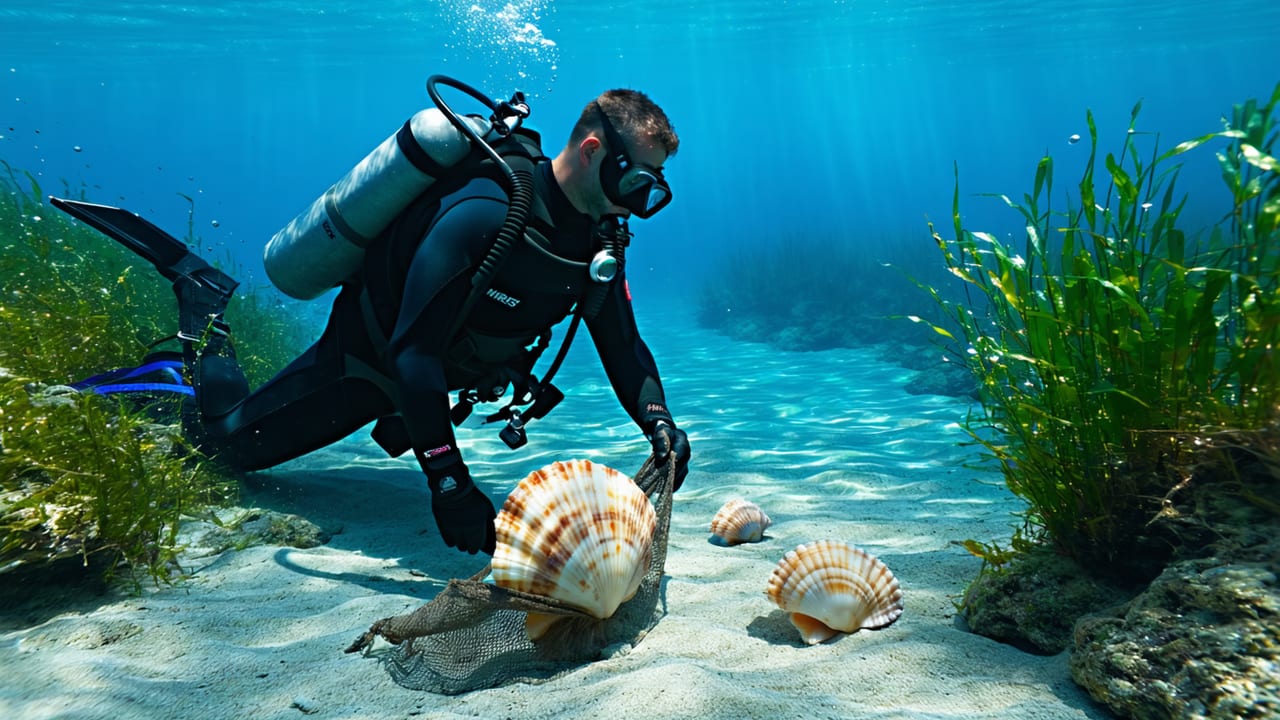
Most wild scallops are caught with dredges; a small premium share is picked by hand by divers.
How scallops are caught
- Dredge: a metal frame with a chain bag towed over the seabed; the main method for US sea scallops and UK king scallops (NOAA).
- Hand-dived ("diver") scallops: picked one by one by divers; less seabed impact and usually less grit.
- Farmed: grown in nets or on lines, mainly in Asia and some in Europe and Canada.
Sources: NOAA Fisheries – Atlantic Sea Scallop · Marine Conservation Society – Good Fish Guide
How the US fishery is managed
The US Atlantic sea scallop fishery uses rotational areas that are closed and reopened so scallops can grow, along with limits on days at sea and crew size (NOAA).
Where Scallops Live
Atlantic sea scallops live on sandy and gravel seabeds offshore, mainly from the Gulf of Maine to the Mid-Atlantic, and are harvested commercially by dredge. Bay scallops live in shallow, grassy bays and estuaries, and these are the scallops recreational harvesters gather by hand.
Best Season and Time
Recreational bay scalloping is seasonal and set by each state. Calm, clear water around midday makes scallops easiest to spot in the seagrass. Check your state's current season dates before you go.
Gear and Techniques
- Snorkel, mask and fins for shallow grass flats.
- A mesh bag to hold your catch.
- A dive flag where required by law.
- Look for the line of blue eyes along the shell edge in the seagrass, then pick scallops up by hand.
Regulations, Limits and Licenses
Seasons, open areas, daily limits and license rules are set by each state and change often. Read the current rules from your state wildlife agency before you go. We do not list limits here because they change. Also check local shellfish advisories, since some areas close after algal blooms or heavy rain.
From Catch to Kitchen
Keep scallops on ice and shuck them the same day: slide a knife along the flat shell, cut the muscle free, and discard everything but the white adductor muscle. Then follow our cooking tips and recipes.
How Commercial Scallops Are Caught
Most US sea scallops are caught with scallop dredges, metal frames with chain-mesh bags towed along the seabed. Some are caught in trawls. To protect scallop beds, NOAA Fisheries uses rotational area management: some fishing areas are closed for years so young scallops can grow, then reopened. There are also limits on crew size, days at sea and dredge size.
Divers hand-gather some scallops, which are sold as "diver scallops". Farmed scallops, mainly in Asia, are grown on ropes or in cages hung in the water.
Safety When Gathering Scallops
Only harvest scallops from areas your state has opened for shellfish. Areas can close after harmful algal blooms or pollution, and the toxins involved are not destroyed by cooking. If you keep anything beyond the white muscle, such as the roe or the whole scallop, follow your state's shellfish rules. Watch for boat traffic when snorkeling, use a dive flag where required, and never snorkel alone.
Sources: US FDA – National Shellfish Sanitation Program (NSSP) · US EPA – Choose Fish and Shellfish Wisely (fish advisories)
Scallop Life Cycle and Habitat
Scallops start life as tiny larvae drifting in the water before settling on the bottom. Bay scallops live only a year or two and grow quickly, which is why their populations can rise and fall sharply from year to year. Atlantic sea scallops live much longer and grow larger. Both depend on healthy seabed habitat, seagrass in the case of bay scallops, which is why managers protect beds and limit harvest.
Before You Go
- Check your state wildlife agency for open seasons, open areas and daily limits.
- Check whether you need a saltwater fishing license for scalloping where you are.
- Check state shellfish harvest-area status and any algal bloom closures.
- Bring a cooler with ice to keep your catch cold until you shuck it.
Source: US FDA – National Shellfish Sanitation Program (NSSP)
How to Shuck a Scallop
Shuck scallops the day you gather them. If you keep anything beyond the white muscle, follow your state's shellfish rules.
- Hold the scallop flat side up, with the hinge facing you.
- Slide a thin, flexible knife between the shells and run it along the inside of the top shell to cut the muscle free.
- Lift off the top shell, then scrape away the skirt and dark guts, leaving the white muscle (and the roe, if you keep it and your state allows).
- Slide the knife under the muscle to free it from the bottom shell.
- Rinse the muscle quickly in cold water, pat it dry and keep it on ice.
Source: US FDA – National Shellfish Sanitation Program (NSSP)
Scallop Farming
Much of the world's scallop supply is farmed, especially in China and Japan, where scallops are grown in hanging nets or lantern baskets or seeded onto the seabed. Small farms also grow scallops in parts of Maine and other US coastal states. Scallops are filter feeders and need no added feed, so farming can be a lower-impact form of seafood production when it is well managed. Look for ASC certification on farmed scallops.
Source: Aquaculture Stewardship Council
After the Trip
Keep shucked scallop meat on ice and cook or freeze it the same day. Rinse your gear in fresh water, and dispose of shells and guts as your state or local marina advises; some areas ask scallopers not to dump them near docks or swimming areas. Report any tagged scallops or unusual finds to your state wildlife agency.
Source: Florida Fish and Wildlife Conservation Commission – Stone Crab (recreational rules)
FAQs
When is scallop season?
Bay scallop seasons are set by each state, often in summer. Check your state wildlife agency for current dates.
Do you need a license to harvest scallops?
Often, yes. Rules vary by state; check before you go.
How do you clean scallops after catching them?
Shuck them the same day, keep only the white muscle, and keep them on ice.
How do I keep scallops fresh after catching them?
Put them on ice in a cooler straight away, shuck them the same day, and keep the meat cold until you cook or freeze it.